
Dunedin: Honest guide to NZ's underrated Scottish south
Wildlife, heritage, and a working university town three hours south of Queenstown. What's worth doing in Dunedin, what to skip, and when to go.
Should you go?
Dunedin is the South Island’s quietest big city and one of the most consistently underrated stops on a NZ itinerary. It’s three and a half hours south of Queenstown but the contrast is total: instead of an alpine resort priced for international honeymooners, you get a working university town with Victorian bones, a wildlife coastline 20 minutes from the CBD, and dinner reservations you can actually get the same day.
The pitch is specific. You come for the Otago Peninsula, which is one of the only places in the world where you can see royal albatross nesting, yellow-eyed penguins (one of the rarest penguin species on earth), fur seals, sea lions, and shags inside a single afternoon. You stay for the heritage: the Octagon, the railway station that looks like a wedding cake, Olveston, Larnach Castle, and a CBD packed with Victorian and Edwardian buildings (check the Dunedin Heritage Trust for current listings). You leave understanding why locals refer to it as the Edinburgh of the South without flinching.
The catch is honest. Dunedin is small. The dining scene is good but not deep, the bar scene is mostly students, and on a wet southern Sunday in winter the city can feel closed. It’s also flatter on the spectacle scale than Queenstown or Milford, the wins here are slower and quieter. If you’re chasing alpine drama, skip it. If you want wildlife, architecture, and a town that still feels like itself, two nights here is one of the better calls you can make on a South Island trip.
Getting there
From Christchurch and Queenstown
From Christchurch it’s a 4 hour 30 minute drive south on SH1 via Timaru and Oamaru. Easy driving, mostly flat, and if you’ve got a half day to spare both Oamaru (Steampunk HQ, little blue penguins, Victorian precinct) and the Moeraki Boulders are worth the stop. InterCity coach takes around 6 hours.
From Queenstown it’s 3 hours 30 on SH6 then SH8, through Cromwell, Alexandra, and Roxburgh. The route is sealed the whole way and runs through Central Otago wine country and stone-fruit orchards, which is a more interesting drive than the map suggests. There’s a coffee stop in Cromwell and a lunch stop in Roxburgh or Lawrence.
Flying in
Dunedin Airport (DUD) sits at Momona, 30 km south of the CBD, which is one of the longer airport runs in NZ. Air NZ flies daily from Auckland, Wellington, and Christchurch. Low-cost carriers like Jetstar appear on trunk routes from time to time (check the Dunedin Airport flight info page for current schedules). There are no scheduled direct international flights, you’ll connect through Auckland or Christchurch.
From the airport: shuttle services (Super Shuttle and similar) and taxis/Ubers are the only options, with taxi fares typically several times the shuttle price (check the official operator sites for current fares). There’s no public bus from the airport into town, which is the single biggest infrastructure gap of Dunedin tourism.
The marquee things
The Otago Peninsula wildlife
This is the single best reason to come to Dunedin. The peninsula runs 20 km east from the city and packs in three of NZ’s most spectacular wildlife encounters.
- Royal Albatross Centre at Taiaroa Head: the only mainland royal albatross breeding colony in the world. Guided tours run roughly NZD $60 to $75 per adult depending on the package, with combo tours including the historic Fort Taiaroa disappearing gun at the upper end. Best wind is afternoon when the birds soar overhead.
- Penguin Place: privately run conservation reserve for yellow-eyed penguins (hoiho). You walk a network of camouflaged trenches to viewing hides. Expect around NZD $60 to $75 per adult for the guided conservation tour. Ethical, small group, and the only reliable way to see hoiho.
- Nature’s Wonders Naturally / Pilots Beach: fur seals, blue penguins at dusk, sea lions on the beach. Argo (8-wheel buggy) tours run across a working farm.
If you only have one afternoon, drive yourself out to the peninsula, do the albatross tour at Taiaroa Head, then walk down to Pilots Beach at dusk for the little blue penguin return. The beach viewing platform is free.
Baldwin Street
The world’s steepest residential street is a 10-minute drive from the CBD in North East Valley. The signage says 35 percent gradient at the steepest section. Walk up, take the photo at the top, walk down. The whole experience is 20 minutes and free.
Two things nobody tells you: it’s a normal residential street, so be quiet and don’t block driveways. And the lower half lulls you into thinking it’s not that steep, the top third is where it bites. Wear shoes with grip if it’s been raining.
Olveston, Larnach Castle, and Otago Museum
Dunedin’s three best heritage paid attractions, each different enough that doing all three is reasonable if you have a slow day.
- Olveston Historic Home is an Edwardian merchant’s house from 1906, kept almost exactly as the family left it in 1966. Allow around NZD $30 per adult for a one-hour guided tour (check the official website for current prices and tour times). Best for: anyone interested in domestic history and old objects.
- Larnach Castle on the peninsula is NZ’s only castle, built 1871 for politician William Larnach. Combined castle and garden entry sits around NZD $35 to $40 per adult, garden-only is cheaper. The gardens are a registered Garden of International Significance and worth as much time as the building.
- Otago Museum in central Dunedin is free general entry, with a paid tropical butterfly forest and planetarium. Strong Pacific and natural history collections. Good rainy-day pick.
Tunnel Beach
A short, steep coastal walk southwest of the city, ending at a sandstone tunnel that was hand-cut in the 1870s so a local landowner’s family could access a private beach (check the DOC site for current history and access info). The walk is 30 minutes down, 45 back up. Free.
Two warnings: the access track can be closed for lambing season in spring and is subject to temporary closures for maintenance or severe weather (check the DOC alerts page before you go). And the beach itself is tidal, check the tide before you go or you’ll arrive at a tunnel opening to seawater.
Speights Brewery and the food scene
Speights has brewed in Dunedin since 1876 and the heritage tour at the original site runs 75 to 90 minutes including tastings, around NZD $35 to $40 per adult. Book ahead in peak season. Touristy but the building is genuinely original and the beer’s drinkable.
For food, the CBD around George Street and the Octagon punches above what you’d expect. Vault 21, Etrusco, No 7 Balmac, Plato, and Esplanade in St Clair are the long-running names locals reference (check current opening hours and menus before booking). Coffee is a serious scene, partly because of the student population: try Strictly Coffee, Vanguard, Allpress Espresso, or Modaks. OCHO (Otago Chocolate Company) runs a CBD factory shop that filled the gap left by Cadbury.
Day trips
The Otago Peninsula in detail
If you do the peninsula properly, allow a full day, not a half. The drive out via the harbour-edge Portobello Road is slow and worth it (lots of bays, fishing boats, the occasional sea lion on the verge). Stop at Glenfalloch Woodland Garden for coffee on the way out, do Larnach Castle mid-morning, eat lunch at Macandrew Bay or 1908 Cafe in Portobello, then do the albatross tour at Taiaroa Head mid-afternoon. End at Pilots Beach for the blue penguin return at dusk.
Return via the back road, the Highcliff Road, which climbs over the peninsula spine and gives the best harbour views in the region. Slower but better. Total day distance is around 80 km.
The Catlins coast
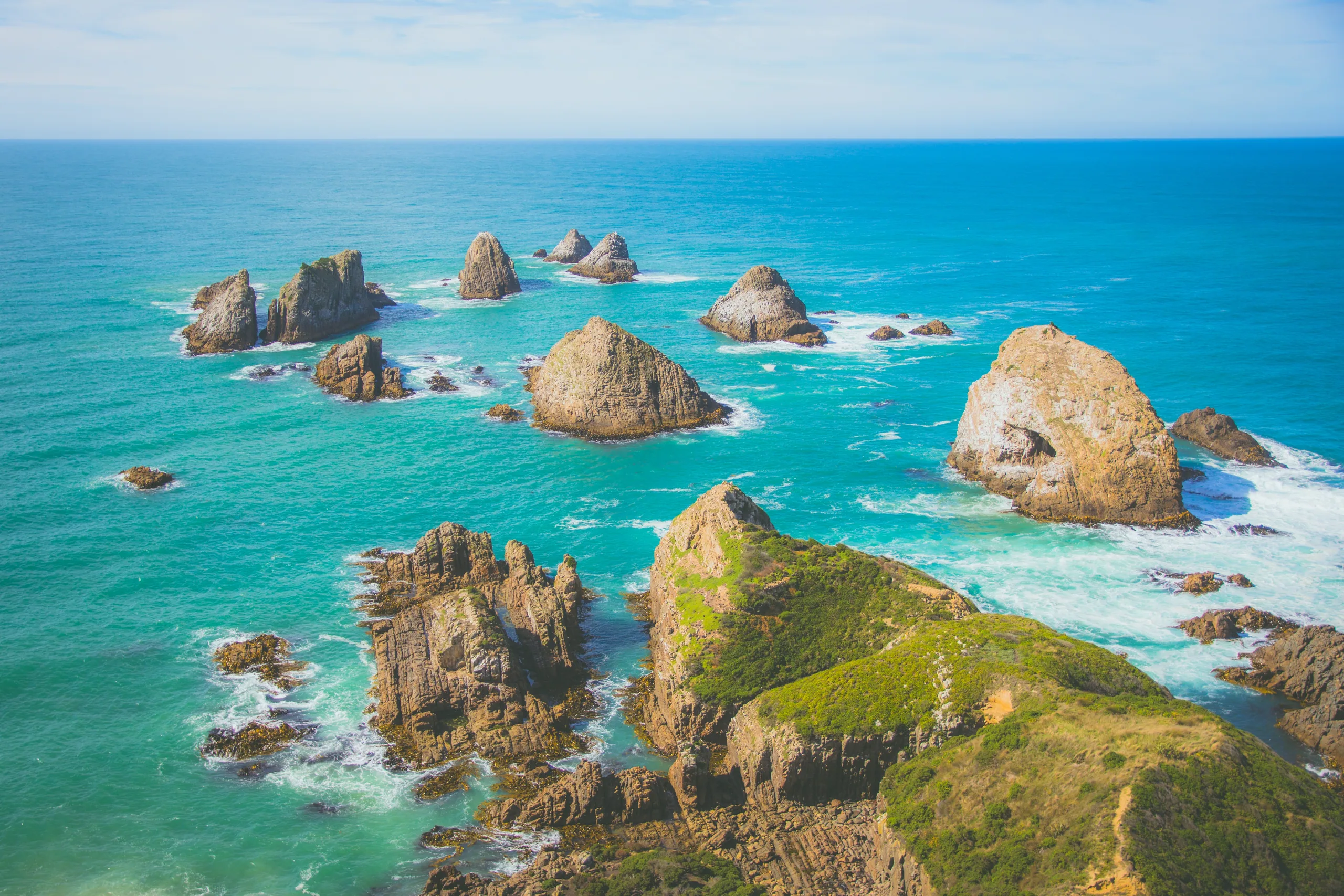
A 1 hour 30 minute drive south of Dunedin gets you into the Catlins, a remote coastal stretch between Dunedin and Invercargill that most international visitors miss entirely. Highlights are Nugget Point lighthouse (45 minutes from Balclutha), Cathedral Caves (tidal, check times), Purakaunui Falls, and Curio Bay for petrified forest and Hector’s dolphins in nearby Porpoise Bay (sightings are seasonal, check with the visitor centre).
It’s a long day from Dunedin (10 to 12 hours round trip) but doable if you start at 7. The better play is to overnight in Owaka or Papatowai and do the Catlins in two days as part of a Dunedin to Invercargill or Te Anau route.
Where to stay
Dunedin is compact enough that location matters less than in bigger cities, but there are a few clear neighbourhoods.
- The Octagon and CBD: walking distance to restaurants, the museum, the railway station, and most bars. Distillery, Scenic Hotel, Kingsgate, and Bluestone on George are the steady mid-range options here.
- North Dunedin (around the university): cheaper, near Baldwin Street, plenty of student-area cafes, quieter at night outside semester. Mid-range guesthouses and Airbnbs dominate.
- St Clair and St Kilda: 10 minutes south of the CBD by car, beachfront, surf, the Hot Salt Water Pool, and the Esplanade restaurant strip. Best if you have a car and want a beach-walk morning.
- Port Chalmers and Macandrew Bay: 15 to 20 minutes from the CBD on the harbour, characterful, quiet, peninsula-adjacent. Good for two nights with a wildlife focus.
- Mosgiel: 20 minutes inland. Cheaper accommodation, but a needless commute unless you specifically want airport proximity.
Budget hostels exist in the CBD (Hogwartz, Kiwis Nest, On Top Backpackers). Top-end pickings are limited compared to Queenstown: the suites at Larnach Castle Lodge on the peninsula and a handful of boutique heritage hotels in the CBD are the main options (check the official operator sites for current availability).
When to go (and the southern weather)
Dunedin sits at 45 degrees south. It gets long summer days (sunset past 9:30pm in late December) and short winter ones (sunset 5pm in June). The weather is genuinely four-seasons-in-a-day, drier than the West Coast but cloudier and colder than Central Otago.
Peak season runs December to March with a pronounced spike from late December to mid-February, when Otago accommodation is busiest and central Dunedin hotels often fill 2 to 6 weeks ahead in high summer. For Christmas to New Year and late January, book at least a month ahead if you want a central, walkable location.
- December to February (summer): warmest, longest days, peak crowds. Daytime highs are typically in the high teens to low twenties Celsius (check MetService for current averages). Cruise ships arrive at Port Chalmers and the CBD can briefly feel busy.
- March to May (autumn): shoulder, the best month is March. Warm enough, fewer people, university back in session so the city is alive but not packed.
- June to August (winter): cold (single-digit to low-teens highs), often grey, short daylight. Accommodation is cheap. Wildlife is still there but penguin viewing requires more layers than you think.
- September to November (spring): variable. Tunnel Beach can close for lambing, but otherwise a fine time. October daffodils through the Botanic Garden are worth a walk.
Pack layers regardless of season. The wind off the harbour is the variable that catches people out, a 16-degree day on the peninsula with a southerly feels like 8.
Skip this if…
A few honest reasons not to come, or to keep it short:
- You want alpine scenery and adventure activities. Dunedin has hills and a harbour, not mountains. Stay in Queenstown or Wanaka instead.
- You’re not interested in wildlife or heritage. Without those two anchors, two nights in Dunedin is hard to fill.
- You’re on a tight one-week South Island trip and you’ve already got Christchurch, Queenstown, and Milford booked. Dunedin is a stretch in that itinerary, save it for next time.
- You travel only by public transport and only fly. The airport connection is poor, the city sprawls, and the best things (peninsula, Tunnel Beach, Catlins) need a car.
The practical stuff nobody mentions
- Rent a car. This is the single most important Dunedin tip. The peninsula, Tunnel Beach, the airport, and the Catlins all assume you have one. Without it you’re either paying for tours or skipping the best bits.
- Book the albatross tour ahead in summer. Tour slots cap out and walk-up availability disappears between Christmas and February. Penguin Place sells out similarly.
- Pilots Beach is free, the bus is not. The blue penguin viewing at Pilots Beach (next to the Royal Albatross Centre) costs nothing if you’re already on the peninsula. The dedicated evening penguin tours from town add NZD $50+ each.
- Cruise ship days are crowded. When a ship is in at Port Chalmers, the CBD, railway station, and peninsula attractions all spike between 10am and 3pm. Check the Port Otago cruise schedule before booking attractions on a specific day.
- St Clair has the best morning. Coffee at the Esplanade, walk the beach, swim if you’re hardy (Hot Salt Water Pool if you’re not), then drive into the city. Better than starting in the CBD.
- Dunedin Hospital is a teaching hospital. If you need urgent care you’ll be seen well, but elective and non-urgent pharmacy hours are limited on weekends. Plan prescription refills for weekdays.
- The student population leaves in November. Mid-November to late February the university is on break and parts of North Dunedin feel oddly quiet. Cafes near campus run shorter hours.
- You can do a free architecture walk. The i-SITE on the Octagon hands out a printed heritage walking-tour map of the CBD that covers about two hours and most of the buildings worth seeing.
Dunedin rewards travellers who slow down and pick a focus. Wildlife day on the peninsula, heritage walk in the CBD, one good dinner, one slow morning at St Clair, and you’ve covered the brief. Try to “do” it like Queenstown and you’ll leave wondering what the fuss was about. For Catlins planning, check the DOC Catlins Forest Park page.