TranzAlpine train: an honest passenger's guide
Riding the TranzAlpine from Christchurch to Greymouth: which class to book, whether to do it one-way or return, and the bits the brochures skip.
Should you go?
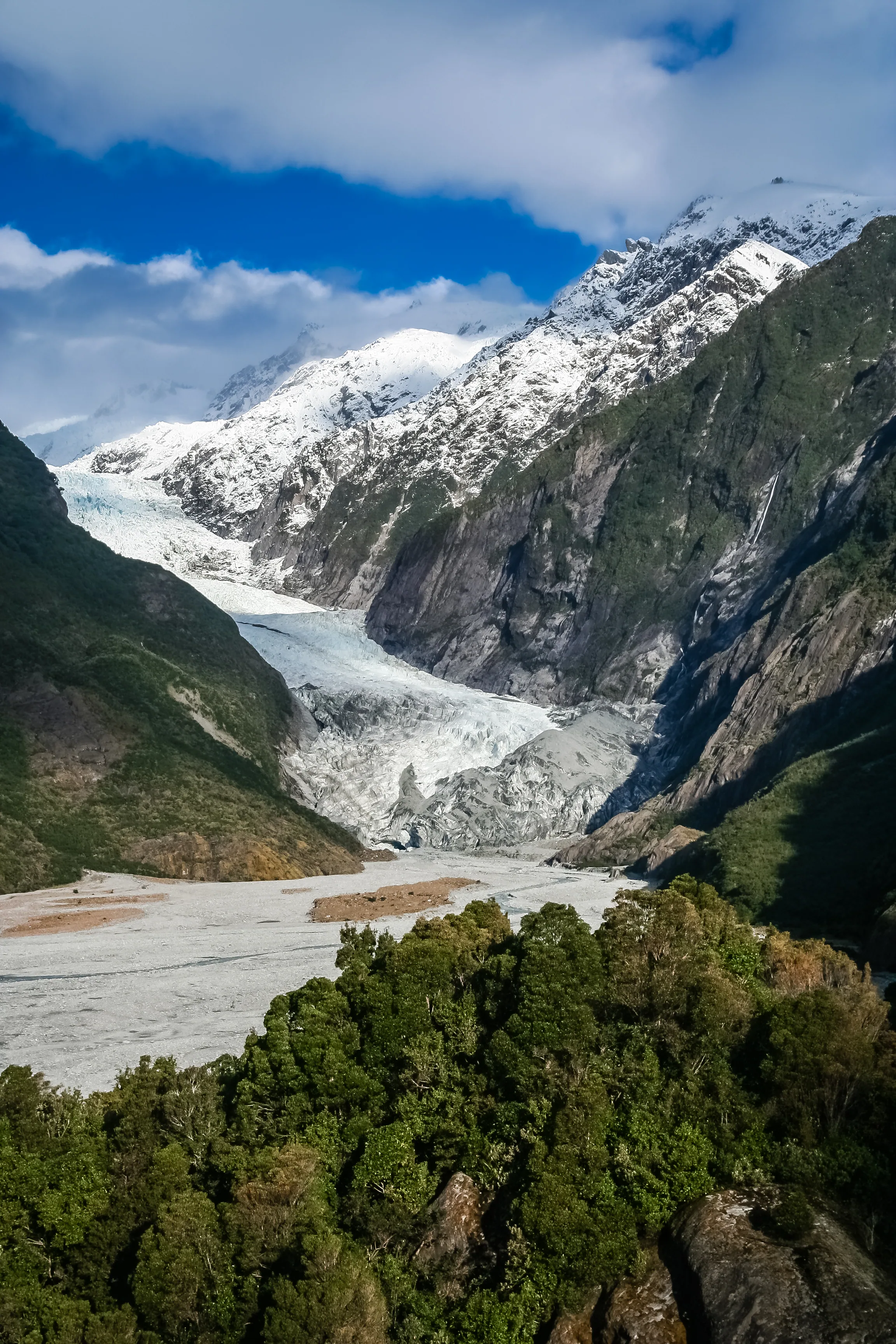
If you’ve got a spare day in Christchurch and any interest in scenery, yes. The TranzAlpine earns its place on most “great train journeys of the world” lists not through marketing but through honest geography. You start on the flat Canterbury Plains, climb through the braided Waimakariri River valley, cross the spine of the Southern Alps at Arthur’s Pass, drop through the dramatic Otira Tunnel and Viaduct, and finish in the temperate rainforest of the West Coast. All in five hours. There is nothing else in New Zealand that gives you that range of country in one sitting.
The catch is that it’s a train, not a tour. You don’t get out and walk along the river. You don’t stop at the lookouts. You sit in a comfortable seat with a large window, watch it all roll past, and either let that be enough or feel like you’re being shown postcards through glass. The open-air viewing carriage in the middle of the train is the antidote to that, and it’s where most of the trip’s best moments happen.
The honest version: book Scenic class one-way, get to the open-air carriage early at Springfield, stay there through Arthur’s Pass, and the TranzAlpine is one of the best days you’ll have in New Zealand. Book Scenic Plus return without a plan and you’ll spend a lot of money to sit in a seat for 10 hours.
The route (Christchurch to Greymouth)
The journey covers 223 kilometres and climbs from sea level at Christchurch to 737 metres at Arthur’s Pass before dropping back down to sea level on the West Coast. The train makes a handful of stops along the way (Rolleston, Darfield, Springfield, Arthur’s Pass, Otira, Moana, Brunner), but most passengers stay on for the full route. Here is what to actually watch for.
The Canterbury Plains start
The first hour out of Christchurch is flat. Very flat. The train rolls west across the patchwork of dairy, sheep, and arable farms that make up the Canterbury Plains, with the Southern Alps slowly building on the horizon. It’s pleasant and pastoral and a useful chance to settle in, get a coffee from the café-bar carriage, and figure out where the open-air carriage is. Don’t expect drama yet.
The scenery turns at Springfield, the last town before the climb. The Alps are now directly ahead, the river valleys deepen, and the train starts to climb in earnest. This is the right moment to move to the open-air carriage if you haven’t already.
Arthur’s Pass and the Otira Viaduct
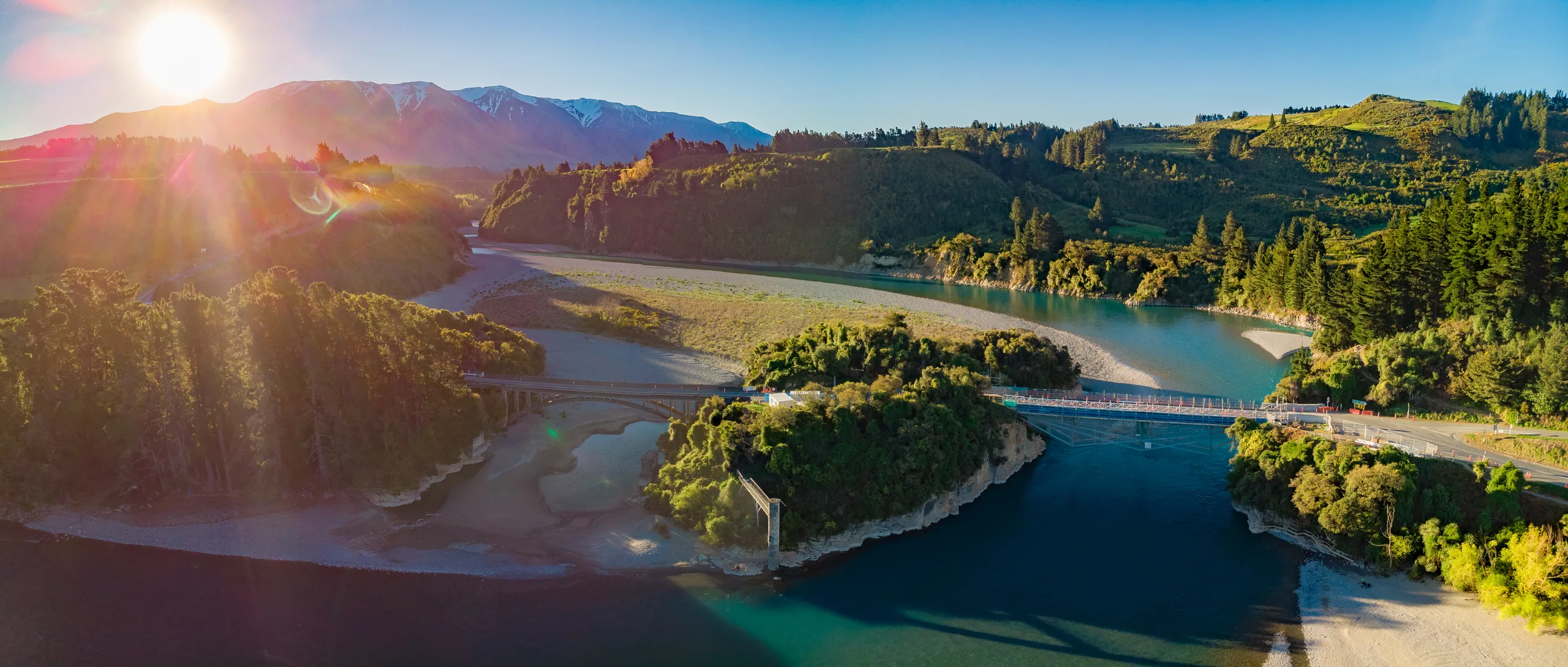
The next hour is the headline act. The train climbs through the Waimakariri Gorge, hugging cliffs above the braided river, crossing a series of bridges and viaducts. The Waimakariri is one of the great braided rivers of the South Island, and watching it spread and split below the carriage windows is one of the journey’s defining images.
At Arthur’s Pass village (737m), the train pauses briefly. You’re now at the highest point of the line, surrounded by alpine peaks, with kea (alpine parrots) often visible on the platform if you’re lucky. Look up at the snow-streaked faces of Mount Rolleston and the Bealey Range.
From here the train enters the Otira Tunnel, an 8.5 kilometre bore through the Main Divide that opened in 1923 and was one of the longest tunnels in the world at the time. You emerge on the West Coast side into a completely different climate: wet, dark, mossy, dramatic. The train then descends past the Otira Viaduct, a feat of late-twentieth-century engineering that replaced an older alignment. Look right (heading west) for the best view of the viaduct curving away below.
The descent to the West Coast
The final 90 minutes are the part most people remember least and probably shouldn’t. The train winds through temperate rainforest along the Taramakau River, past Lake Brunner (Moana), and into the small coal-and-rail town of Greymouth. The light has changed completely from the dry Canterbury start. The bush is denser, the air feels heavier, and you understand viscerally how the Southern Alps split the South Island into two entirely different countries.
Greymouth itself is functional rather than charming. The station is the train’s terminus and the launch point for whatever comes next.
Classes and pricing
There are two classes on the TranzAlpine: Scenic and Scenic Plus. Both have access to the open-air viewing carriage. Both have panoramic windows. The difference is service, food, and seating.
Scenic (standard)
Scenic is the standard carriage and the one most travellers book. Comfortable reclining seats arranged 2-and-1 with large panoramic windows, ample legroom, and access to a shared café-bar carriage where you can buy hot food, snacks, coffee, wine, and beer at fair (not airline-tier) prices. There’s onboard commentary via GPS-triggered headphones, free Wi-Fi (intermittent through the mountains), and power outlets at each seat.
Adult fares start at NZD $199 one-way for 2025-26 departures, with peak season pushing $229 to $269. Children (2 to 14) are roughly 70 percent of the adult fare. Return fares are roughly double the one-way price. Book directly with Great Journeys of New Zealand for the best deals, and book early, especially for summer and school holidays.
Scenic Plus (premium)
Scenic Plus is the premium carriage and a different experience. You get a dedicated carriage with table seating (2-and-2 facing across a shared table), all meals and drinks included (a three-course brunch and afternoon tea heading west, lunch and afternoon tea heading east), premium New Zealand wines and beers, and more attentive service. The carriage is quieter, less crowded, and the food is genuinely good (think regional cheeses, smoked salmon, slow-cooked lamb, not airline food).
Scenic Plus starts around NZD $429 one-way and can climb to NZD $549+ in peak season. Whether it’s worth it depends on what you value. If food and a slower, more curated experience matter, yes. If you mainly want the scenery and you’d rather spend the difference on a night in Punakaiki, stick with Scenic.
One useful note: Scenic Plus does not give you a better view. The open-air carriage is open to everyone, and the panoramic windows in Scenic are just as large as in Scenic Plus. You’re paying for service, not sightlines.
How to actually do it (round trip vs one-way)
This is the decision that defines your day. The TranzAlpine runs once each way per day. The westbound service leaves Christchurch at 8:15am and arrives Greymouth at 1:05pm. The eastbound returns from Greymouth at 2:05pm, arriving Christchurch at 6:31pm. That gives you exactly one hour in Greymouth if you want to do it as a same-day round trip.
The round trip is fine if you only have one day, you don’t want to organise West Coast accommodation, and you accept that you’ll spend most of the day on the train. You’ll see the same scenery twice in different light, which is genuinely lovely. You’ll also be tired by 7pm and you’ll have eaten lunch in Greymouth, which is not what Greymouth is best at. Roughly NZD $398 to $550 per adult in Scenic depending on season.
The one-way trip is the better trip for most travellers. You take the train west, stay one or more nights on the West Coast (Greymouth itself is functional but Punakaiki, Hokitika, and the Franz Josef and Fox glaciers are all within a few hours), and continue your itinerary from there. Pickup options from Greymouth include rental cars, the InterCity bus network, or shuttles to Punakaiki and the glaciers. If you’re doing a multi-week South Island trip, the TranzAlpine fits naturally as the Christchurch-to-West-Coast transit leg.
A third option: book the train one-way, drive back over Arthur’s Pass (State Highway 73) the next day. You get the train experience plus the road experience plus the freedom to stop at lookouts and short walks. Most thoughtful itineraries do this. Driving advice in our NZ driving guide.
Getting started (Christchurch station)
The TranzAlpine leaves from Christchurch Railway Station in Addington, not the central business district. The address is Troup Drive, off Clarence Street, about 5 kilometres southwest of Cathedral Square. Plan a 10-to-15-minute drive or taxi from the CBD, longer in morning traffic.
- Parking is free at the station for the day. Plenty of space.
- Check-in opens at 7am for the 8:15am departure. Aim to be there by 7:30am.
- Luggage can be checked in at the platform (you’ll get a tag, and it travels in a baggage car). Small carry-on bags stay with you.
- Food and coffee are available at a small station café, but it’s basic. Better to grab coffee in the CBD on the way.
- Toilets are on the train and at the station.
Boarding is by carriage and seat, so know your booking. Scenic Plus passengers board their own dedicated carriage. The open-air viewing carriage is shared and accessible from any other carriage via the inter-carriage doors.
When to go
There is genuinely no bad season for the TranzAlpine, only different ones.
- Winter (June to August) is the postcard. Snow on the peaks, frozen waterfalls in the Waimakariri Gorge, occasional fresh snow on the platforms at Arthur’s Pass. Days are shorter, so the return leg can be partly in the dark in midwinter. Coldest in the open-air carriage. Bring a beanie and gloves.
- Spring (September to November) is unpredictable and lovely. Snowmelt fills the rivers, the bush is bright green on the West Coast side, and you can get any kind of weather in a single day.
- Summer (December to February) is busiest. Long daylight, warm temperatures, the easiest weather. Book well ahead, especially around Christmas and New Year.
- Autumn (April to May) is the underrated season. Golden beech forest in the Waimakariri Valley, settled weather, fewer crowds. Many regulars say this is the best time.
A note on bad weather: the TranzAlpine runs in almost any conditions. Heavy snow, rain, and wind don’t usually cancel the train. Visibility through the Otira Tunnel section is obviously unaffected by weather, and a moody, rain-streaked Waimakariri can look even more dramatic than a blue-sky day. Don’t reschedule unless the forecast is genuinely bad for the whole region.
Skip this if…
A few honest reasons to drop the TranzAlpine from your itinerary:
- You’ve already driven Arthur’s Pass and you saw most of the same country from the road, with the freedom to stop. The train adds the Otira Tunnel and Viaduct sections and the open-air carriage, but you’ve seen the headline scenery.
- You’re tight on time and the choice is between the TranzAlpine round trip and a day in the actual mountains (a Mount Cook flight, a Franz Josef glacier walk, a Banks Peninsula day trip). The active experiences win on most short trips.
- You don’t like sitting still. Five hours is a long time, even with the open-air carriage. If you fidget, take the road instead.
- You’re trying to do the West Coast on a rigid coach itinerary. The train one-way is great, but if you then need to get back to Christchurch by a specific time, the logistics can get messy. Plan it as part of a one-way South Island loop, not a there-and-back.
The practical stuff nobody mentions
A short list of things that will improve your day:
- The open-air viewing carriage is the best seat on the train. It’s open to everyone, but it gets crowded through Arthur’s Pass. Move there at Springfield (about 90 minutes in) and stake out a spot before the climb starts.
- It is COLD in the open-air carriage. Even in summer, the wind chill at 700+ metres elevation can be sharp. In winter, freezing. Take a proper warm jacket, a beanie, and consider gloves. Most people regret not bringing more layers, not the other way around.
- Photography is better through the open-air carriage than through the panoramic windows, which can reflect interior light and pick up scratches. Bring a wide lens for landscapes and a zoom for the kea at Arthur’s Pass. Steady your camera against the railing for the bridge and viaduct shots. There is no glass, so be careful with hats and small accessories.
- The café-bar carriage gets busy around 9:30am and again around 11am. Order coffee and a snack before Springfield, or wait until after Arthur’s Pass when it quietens down.
- Wi-Fi works in patches. Don’t plan to do real work. Download anything you need offline before you board. Phone signal disappears completely through Arthur’s Pass and most of the Otira section.
- The onboard commentary is GPS-triggered and genuinely informative. Plug headphones into the seat jack or use the app. It’s the difference between watching scenery and understanding why it looks the way it does.
- There are no luggage restrictions like a flight. You can check in normal-sized suitcases for free, which makes the one-way + continue-the-trip plan painless.
- The train sells out on weekends, school holidays, and most of summer. Book at least 2 to 4 weeks ahead in those periods. Last-minute fares jump significantly when seats get tight.
If you’ve got the day and the curiosity, ride the TranzAlpine one-way, take the open-air carriage at Springfield, and let the South Island show off. It’s the easiest way to feel the scale of the country in five hours. Pair it with our 7-day South Island itinerary for the wider plan.